LLMs are great but are not making Recommender systems obsolete (yet)

LLMs are great and can do mind-boggling things with their language comprehension capabilities. They have generative abilities that make them seem like oracles, but please caution yourself because they are not.

Stuffing an LLM into a recommender system does not solve all problems. In fact, they might create quite a few more than they will solve at this point.

That’s not to say that they don’t have a place in the world of RecSys, but it is another component rather than a replacement altogether. The idea that it will make behavioral data obsolete seems a bit naive to me. Language Models can enhance recommender systems. LLMs significantly enhance recommender systems by leveraging their advanced language comprehension capabilities to generate personalized recommendations. However, it’s essential to recognize their limitations. While they excel in understanding language, they may not adequately address all complexities of user behavior and context, potentially creating more issues than they solve.

Does the solution have to contain machine learning?

Does a solution have to contain machine learning to be good or to tap into the voice of the many – do we need to have an LLM?

In many cases, the answer might be no, for sure not as the first solution. If you consider recommender systems or reranking models, simply reordering them according to recency can significantly improve the experience.

But of course, don’t stop there. There can be many more things to try which might be possible improvements. However, one of the most significant issues of recommender development is that it is tough to evaluate a system without testing it on users. If you have a simple idea that could improve your KPI, it will likely earn you a lot of money while battling with more complex algorithms.

Having something simple in production also enables you to start evaluating and monitoring and ensure you have set up the collection of data needed before adding more complexity to the system. A simple solution also provides you not only evidence and data that could enable your (machine learning model/)system to become even better. If nothing else, it provides a benchmark to compare to the much more complex solution.

Dont randomize training data for recommender systems.

When you train machine learning models, you often have to randomize the data so that the model doesn’t learn unintended patterns from the order of training data. In recommender systems, the same concern could be stated. Still, suppose you randomize a user’s data such that a recommender system might know what a user has consumed after the time the recommendations should happen. In that case, you introduce a data leak, which will be a more significant concern.

Training and evaluation of recommender systems are done to make them make customers happy and have better lives. To prepare the recommenders to do that task as well as possible, it’s essential to train them to mimic the environments they should perform in, and that is not a reality where they know things from the future. At least not yet.

You should always pretend events are time-sensitive. When training a recommender, you should split it at a specific timestamp. To stimulate what the recommender can do at that point, knowing the data recorded before. Then, use the remaining data (logged after the timestamp) to evaluate the predictions, i.e. see how many content items the recommender can predict.

I needed to get it off my chest (again).

A book conversation

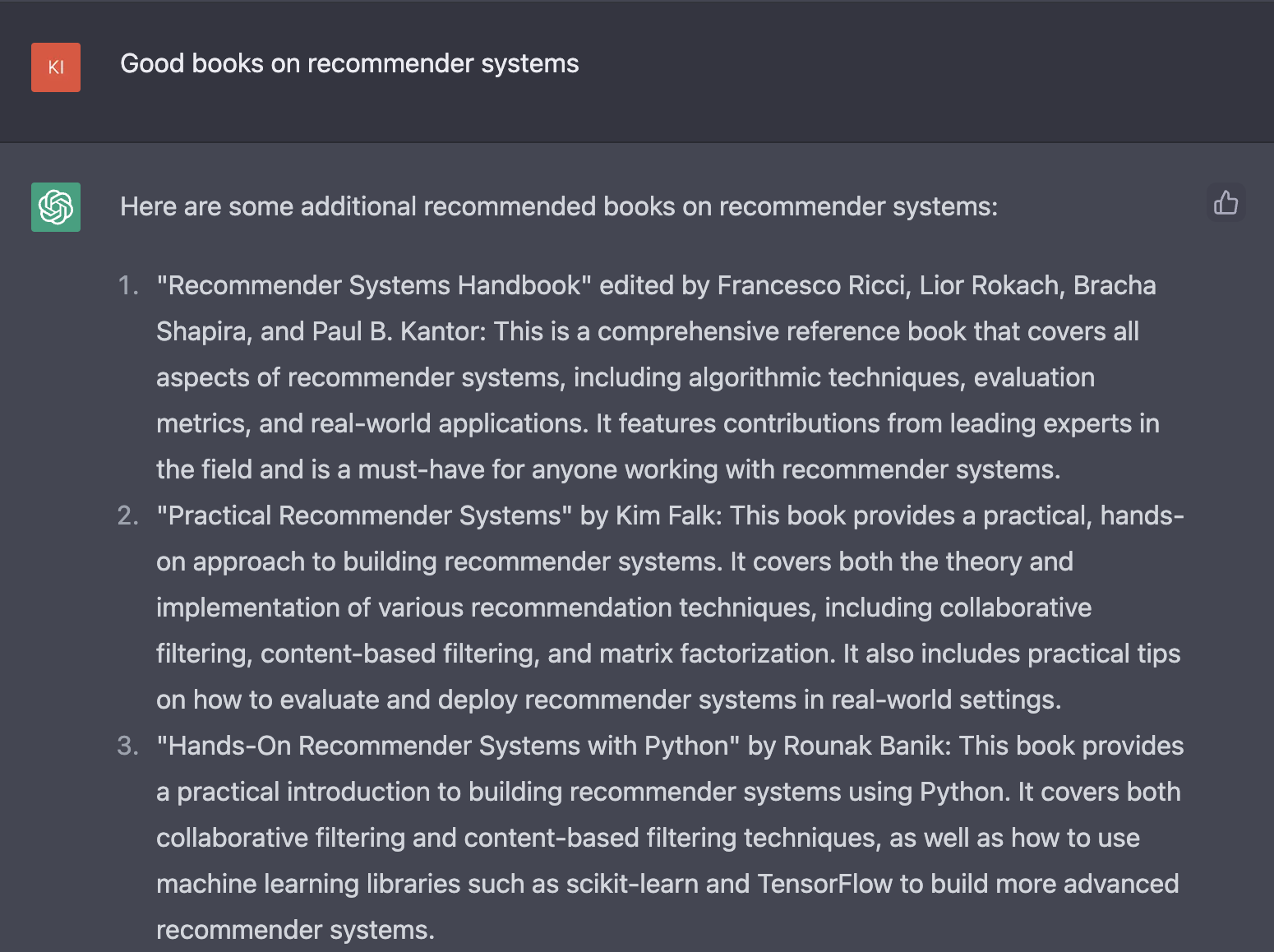
Hi ChatGPT, thank you for recommending my book to me. I am delighted you wrote so positively about it.

What is also worth knowing, before I praise it for being the oracle it must be to recommend my book, is that I actually tried regenerating the text four times, and then when my book didn’t appear, told it that:

Then I reposted the question and finally came up with the version I sought, where it was recommending my book.

You usually never see how much work went into making it say the things it’s quoted to say. Remember, the text is only ever as credible as its sources and writers.

The book​ is Out!

The printed book is out!

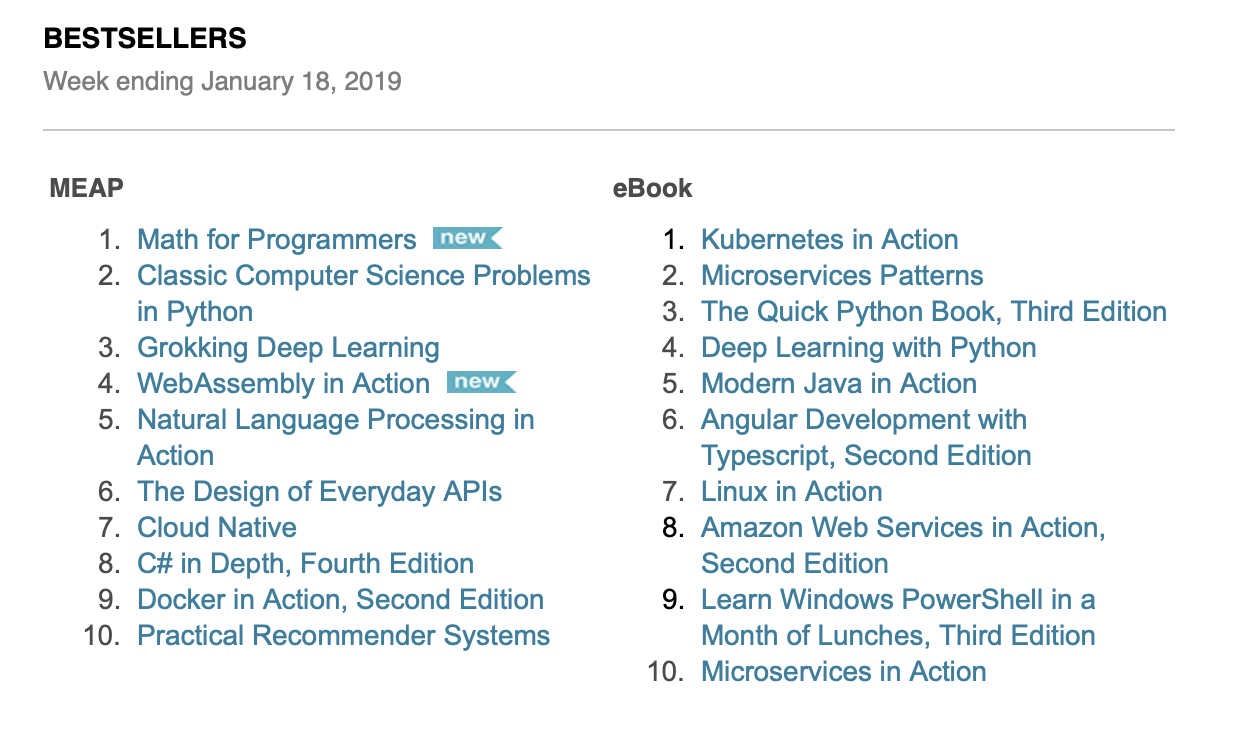
Four years in the making, nothing on the standards of George R. R. Martin, but still a loong time. I was happy to see that last week, before being released fully, it appeared amongst the 10th most sold in Mannings early releases.
Thanks to all who bought it, supported it, reviewed it and waited so long for the final version!

screenshot 2019-01-18 15.24.06

I am delighted it is completed and I hope that you will enjoy it. Please feel free to comment, review or discuss with me. I also do talks if there is an audience that would like to hear about recommenders.

For now, happy days! Can’t wait to hold a paper copy later this week.

The printed book (and the ebook) are available here and will be for sale on all good webshops in the near future.

Get the book here

Introducing Practical Recommender Systems

Practical Recommender Systems

Front page of Practical Recommender Systems

For a computer scientist like me, the world of IT is such an exciting place! Since I started at  university, I have seen the creation of companies like Amazon and Google, and later Netflix. They were for sure lucky to be in the right place at the right time. But it was ingenuity that has kept them in the market. What they did is a long story, but what I find interesting is that they have taken large quantities of content and made it accessible to the masses.

One of the advantages of being an internet business is the fact that you are not limited by physical walls like traditional shops and your list of products can be close to never ending. If a physical store was truly so vast, customers would struggle to find anything and  simply get lost. They would probably  go to the shop next door, which has fewer products and buy things that are not exactly what they wanted, but are easily accessible.

Offering lots of content does not ensure success, not even if you have precisely what your users want. Often 20% of your content will produce 80% of your business, if you can match the rest of the 80% of the content with your users, you will have more happy users and more business. The problem of activating the last 80% of the content is called the long tail problem.

A way to enhance the accessibility to the content for the users is to add a recommender system to you site. This can attempt to predict what your customers want and serve it to them.

Implementation of Recommender systems is an intriguing task. The actual algorithms like collaborative or content-based filtering are just a small part of it. If you do not feed the algorithm with the right data, it will not produce anything worth looking at. Using user ratings will often not produce the results that users want. Looking at context is also often something worth thinking about. And when it is all implemented and running, how do you know that it is working, how do you measure improvements?

I never found a book answering these questions; I found lots of good books explaining how to implement the algorithms mentioned above, but never a book that described everything around as well. So I started working on one. It just came out in an early release at Manning

Go and have a look, the first chapter is free!

Manning.com/falk.